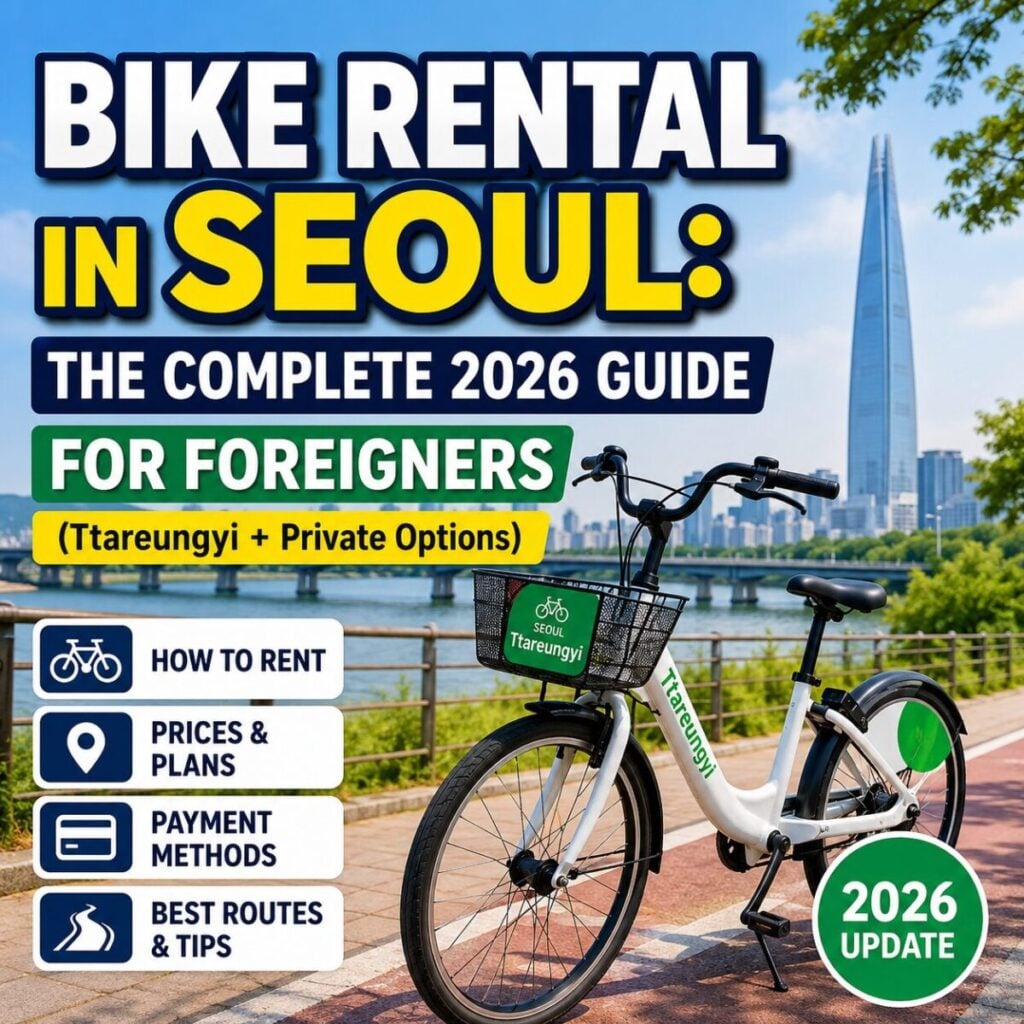
Bike Rental in Seoul: The Complete 2026 Guide for Foreigners (Ttareungyi + Private Options)
Want to explore Seoul by bike but not sure where to start? This guide covers everything you need to know about bike rental in Seoul in 2026: how to use the public bike system (Ttareungyi), private rental shops, best cycling routes (especially along the Han River), costs, safety tips, and common mistakes to avoid.
Why Rent a Bike in Seoul?
Seoul is one of Asia’s most bike-friendly capitals, with extensive dedicated cycling paths, flat riverside routes, and a cheap, well-maintained public bike system. Cycling is an excellent way to:
- See the Han River parks and landmarks at your own pace
- Avoid subway crowds while covering more ground than walking
- Enjoy a low-cost, active, and scenic experience (from just ₩1,000/hour)
Option 1: Seoul’s Public Bike – Ttareungyi (따릉이)
Ttareungyi is Seoul’s government-run bike-share system, with thousands of green bikes and hundreds of docking stations across the city. It’s the cheapest and most convenient option for most visitors.
Who Can Use Ttareungyi?
- Anyone aged 13 or older can use the system.
- Foreign tourists can use it without Korean registration via the “Foreigner (Non-member)” option in the app.
Step-by-Step: How to Rent a Ttareungyi Bike
- Download the “Seoul Bike (Ttareungyi)” app
- Available on iOS (App Store) and Android (Google Play).
- In the app, switch the language to English (top right).
- Choose “Foreigner” / Non-member
- No membership or Korean ID is required.
- You can pay with an international credit/debit card.
- Buy a pass
- Typical options:
- 1-hour pass: ₩1,000
- 2-hour pass: ₩2,000
- The pass is valid for 24 hours and can be used multiple times within that window.
- Typical options:
- Find a nearby station
- Use the in-app map to see stations and available bikes.
- Stations are concentrated around subway stations, parks, and major attractions.
- Unlock a bike
- Most bikes are QR-type:
- Locate the QR code under the seat or on the handlebars.
- In the app, tap “Rent” and scan the QR code.
- The lock will click open automatically.
- Some older LCD-type bikes require entering a rental number on the dock; follow the on-screen prompts.
- Most bikes are QR-type:
- Adjust the saddle and check the bike
- Make sure the seat height suits you and the lock is firm.
- Quickly check brakes, lights, and tires before riding.
How to Return a Ttareungyi Bike
- Return to any Ttareungyi docking station
- You cannot just leave the bike anywhere; it must be docked at an official station.
- Lock the bike properly
- For QR-type bikes: push the bike into the dock and pull the lock lever down until it clicks.
- For LCD-type: connect the dock’s cable to the bike’s frame.
- Confirm return via notification
- You should receive a push or KakaoTalk notification that the return is complete.
- If you don’t get this, the timer may keep running and you could be overcharged.Pro tip: If your bike has a problem (flat tire, broken chain), report it as “Broken” in the app and return within 5 minutes to avoid extra charges and rent another bike immediately.
Pricing & Pass Tips
- Base fare (as of 2025–2026):
- 1 hour: ₩1,000
- 2 hours: ₩2,000
- After the included time, additional fees apply per minute, so it’s smart to return and re-rent before the hour ends if you plan to ride longer.
- The pass is valid for 24 hours from purchase, so you can make many short trips within that period.
Option 2: Private Bike Rentals (For Longer or Specialty Rides)
If you want higher-end bikes, e-bikes, or multi-day rentals without docking constraints, private bike-share or rental shops are a good alternative.
Major Private Bike-Share Services
- Kakao T Bike – widely available in Seoul and other cities; includes standard and e-bikes in some areas.
- Swing, Gcoo – other app-based services operating in parts of Korea.
These usually require:
- App installation and account registration
- Credit card payment
- QR unlock and photo upload when parking (dockless system)
Traditional Bike Rental Shops
In tourist areas like Hongdae, Itaewon, and near major parks, you’ll find small shops renting:
- City bikes, hybrid bikes, and sometimes road or mountain bikes
- Daily or multi-day rates (often ₩10,000–₩30,000/day depending on bike type)
- Helmets, locks, and sometimes child seats or accessories
Search terms like “bike rental Hongdae” or “Seoul bike shop rental” on Naver Map or Google Maps to find nearby options.
Best Cycling Routes in Seoul
Han River (Hangang) Bike Paths
The Han River bike paths are the highlight for cyclists in Seoul, with flat, well-paved, car-free routes stretching for dozens of kilometers along both banks.
Popular sections include:
- Yeouido – Banpo – Ichon
- Great for sunset rides, cherry blossoms in spring, and views of 63 Building and Banpo Bridge.
- Ttukseom – Jamsil
- Passes by Ttukseom Resort, Olympic Park, and Seonyudo Park.
- North Bank (Gangbuk) vs South Bank (Gangnam)
- Both sides have excellent paths; you can cross via bike-friendly bridges (e.g., Banpo, Seongsu, Jamsil).
Use Naver Map or KakaoMap and select the “Bicycle” mode to find dedicated cycling paths and avoid steep or dangerous roads; Google Maps is less reliable for cycling in Korea.
City & Park Routes
- Seoul Forest to Ttukseom Hangang Park – scenic, green, and relatively quiet.
- World Cup Park to Yeouido Hangang Park – ideal for a relaxed evening ride.
- Cheonggyecheon stream area – short, pleasant urban ride, though more pedestrian-heavy.
Safety, Rules, and Practical Tips
- Helmets: Strongly recommended; some areas and age groups may have helmet requirements.
- Traffic rules:
- Use designated bike paths where available.
- Obey traffic signals and signs; do not ride on sidewalks where prohibited.
- Lights and reflectors: Most Ttareungyi bikes have basic lights and reflectors; check before riding at dusk or night.
- Weather:
- Summer can be very hot and humid; carry water and avoid midday heat.
- Winter riding is possible but can be icy; check conditions and dress warmly.
- Theft/Security:
- Ttareungyi bikes must be returned to docks; private dockless bikes should be locked and parked in allowed areas.
- Always take a photo of your parked bike if using a dockless system.
Sample Half-Day Cycling Plan (Foreigner-Friendly)
Afternoon–Evening Han River Ride
- Start at Ichon Station (Line 4), rent a Ttareungyi bike nearby.
- Ride along the south bank towards Banpo Hangang Park (approx. 3–5 km, flat).
- Stop at Banpo for:
- Picnic on the grass
- Views of Banpo Bridge Rainbow Fountain (seasonal)
- Continue to Yeouido Hangang Park via Banpo Bridge bike path.
- Return the bike at a dock near Yeouido Station or ride back to Ichon and return there.
Total riding time: 1.5–2 hours, easily covered with a 2-hour pass plus a quick re-rent if needed.
Common Mistakes to Avoid
- Not confirming return: Always wait for the return notification; otherwise you keep being charged.
- Leaving the bike outside a dock: Ttareungyi bikes must be returned to official stations, not just anywhere.
- Using Google Maps for cycling routes: Prefer Naver Map/KakaoMap with bicycle mode for accurate bike paths.
- Ignoring time limits: If you plan to ride for 3+ hours, return and re-rent before your included time expires to avoid extra per-minute fees.
Quick FAQ
Q: Can I use Ttareungyi without a Korean phone number?
A: Yes. Foreigners can use the non-member pass with an international credit card and email/Kakao for notifications.
Q: Is there an English version of the app?
A: Yes. The Seoul Bike (Ttareungyi) app supports English, Chinese, and Japanese.
Q: Are e-bikes available?
A: Some private services (e.g., Kakao T Bike) offer e-bikes in certain areas; Ttareungyi is primarily standard pedal bikes.
If you tell me your target audience (e.g., budget backpackers, families, luxury travelers) and preferred blog length, I can tailor this further (tone, headings, SEO keywords, meta description, and suggested images).